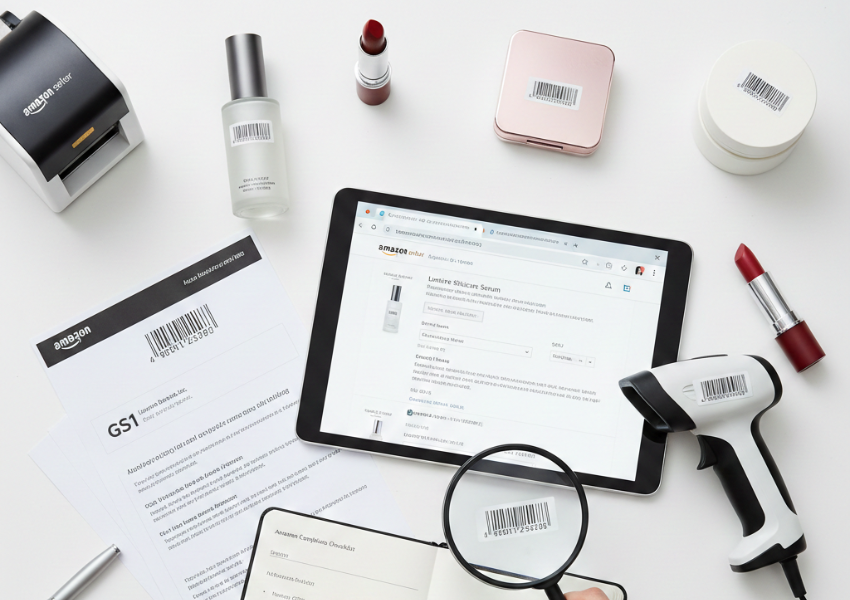
Selling cosmetics on Amazon involves several different types of product identification. A lipstick, foundation, face serum, perfume, or beauty kit may need a product identifier for creating the Amazon listing, while inventory sent through Fulfillment by Amazon (FBA) can also have separate barcode and labeling requirements.
This is where many beauty sellers become confused.
A UPC or EAN used to identify a product is not necessarily the same thing as an Amazon barcode used to track inventory inside FBA. And not every Amazon listing follows exactly the same product-ID route.
Before purchasing barcode numbers or printing cosmetic packaging, understand what Amazon requires for your specific product, brand, marketplace, and fulfillment method.
This guide explains the key barcode considerations for cosmetic sellers in 2026.
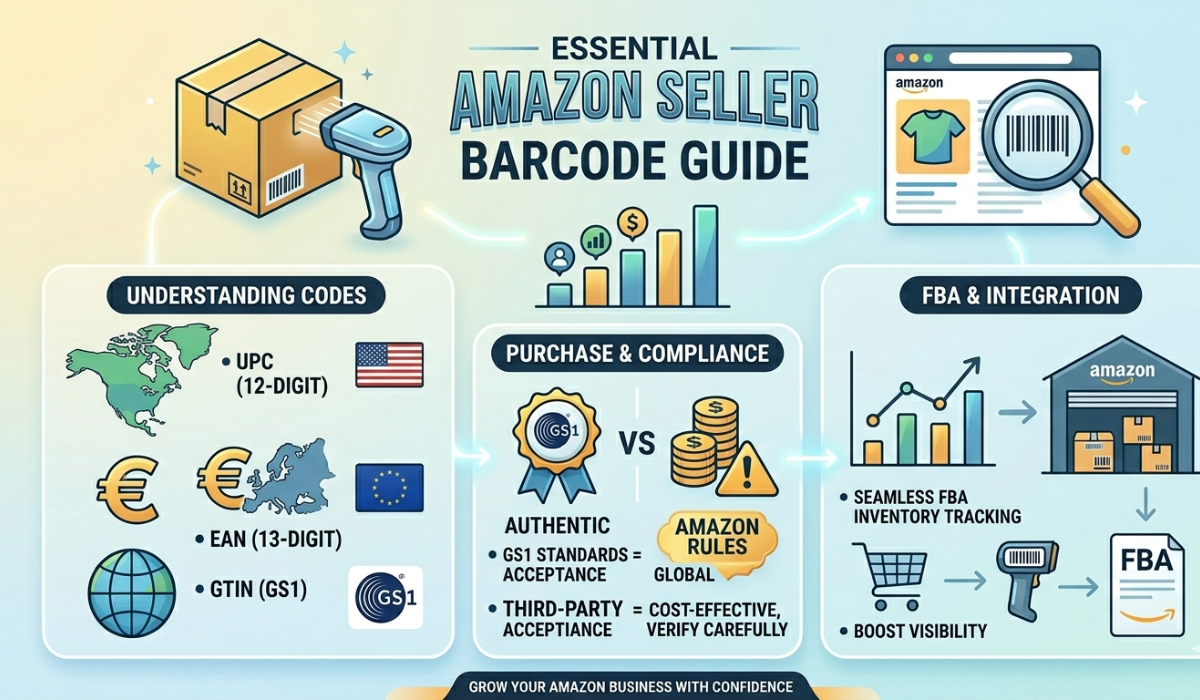
What Is a GTIN on Amazon?
GTIN stands for Global Trade Item Number.
Amazon uses product IDs such as GTINs to identify products, match offers with products already in its catalog, and create new product listings.
Common product identifiers include:
- UPC
- EAN
- JAN
- ISBN for books
For cosmetic products, UPC and EAN are among the identifiers sellers are most likely to encounter.
A GTIN is the identifying number. The familiar black-and-white barcode printed on product packaging is a machine-readable representation used to encode an identifier.
Understanding that distinction makes the rest of Amazon's barcode requirements much easier to follow.
Do Cosmetics Need a Barcode to Sell on Amazon?
There isn't one universal answer for every cosmetic listing.
If the cosmetic product already exists in Amazon's catalog, you may be able to match your offer with the existing product.
If you own or manufacture a new product and need a GTIN, Amazon's current guidance directs sellers to GS1 as a source for obtaining a GTIN.
Amazon also provides a GTIN exemption process for eligible products that do not have a product ID.
Therefore, the correct first step is not automatically purchasing a barcode.
The correct first step is:
Check how Amazon expects your specific product to be listed.
Step 1: Check Whether the Cosmetic Already Exists on Amazon
Before obtaining a new identifier, search Amazon's catalog.
If you're reselling an existing branded cosmetic product, it may already have an established product detail page and identifier.
Amazon's listing workflow allows sellers to search for products and match an offer with an existing listing.
Creating unnecessary duplicate product listings can cause catalog problems.
If you're launching your own new cosmetic product, the process can be different.
Step 2: Determine Whether Amazon Requires a GTIN
When creating a new listing, Amazon may request a product ID.
For a new product that you create and own, Amazon's published guidance identifies GS1 as the organization through which sellers can obtain GTINs.
However, Amazon also provides a GTIN-exemption workflow for eligible products without product IDs.
This distinction matters:
Don't assume that every product automatically needs a newly purchased barcode, and don't assume that every product will qualify for an exemption.
Use Amazon's current listing workflow to determine the appropriate route.
What Is a GTIN Exemption?
A GTIN exemption may allow an eligible product without a product ID to be listed on Amazon without supplying a GTIN.
Amazon's current workflow generally involves starting a new product listing and indicating that the product does not have a product ID. If an exemption is available for the situation, Amazon can present an option to apply.
Amazon may require information and product images as part of the process.
Eligibility can depend on the listing situation, so cosmetic sellers should not treat GTIN exemption as guaranteed.
Check directly through your Seller Central listing workflow.
UPC vs EAN for Cosmetic Products
UPC-A and EAN-13 are widely used retail barcode formats.
UPC-A
UPC-A contains 12 digits and is commonly encountered in the United States and Canada.
Cosmetic examples can include:
- Lipsticks
- Foundations
- Mascara
- Skincare
- Shampoo
- Perfume
- Beauty accessories
EAN-13
EAN-13 contains 13 digits and is commonly encountered across Europe and many international retail markets.
However, don't select UPC or EAN solely because of geography.
Your actual Amazon marketplace, product listing, retailer, distributor, or other trading partner should determine the identifier requirements you follow.
Does Every Cosmetic Shade Need a Different Product Identifier?
Cosmetic catalogs frequently contain large numbers of variations.
A foundation might have 20 shades. A lipstick line might have 12 colors. A moisturizer could be sold in 30 ml and 50 ml sizes.
Within standard GTIN management, distinct product variations such as different colors and sizes are separately identified.
For example:
Lipstick – Ruby Red: 1 identifier
Lipstick – Nude Beige: 1 identifier
Lipstick – Rose Pink: 1 identifier
Likewise:
Serum – 30 ml: 1 identifier
Serum – 50 ml: 1 identifier
Don't use one product identifier indiscriminately across several separately identifiable cosmetic variations.
How Many Barcodes Does a Beauty Brand Need?
Before purchasing anything, map your catalog.
Suppose your beauty brand sells:
- 10 lipstick shades
- 12 foundation shades
- 3 serum sizes
- 4 perfume fragrances
- 2 gift sets
That represents 31 separately identifiable products or variations in this simplified example.
A spreadsheet can help you organize:
Product Name | SKU | Shade | Size | UPC/EAN | Amazon Listing
Planning first prevents confusion later as your catalog grows.
Cosmetic Bundles and Beauty Kits
Beauty brands often sell:
- Skincare sets
- Makeup kits
- Lipstick collections
- Shampoo and conditioner combinations
- Gift boxes
- Promotional bundles
A bundle sold as its own distinct product can require identification separate from the individual items inside it.
For example, a cleanser, toner, and serum may each have their own product identifiers. If all three are also sold together as a distinct skincare set, the set itself can require separate identification.
Don't simply reuse one component's barcode to represent the entire bundle.
GS1-Issued GTINs and Third-Party UPC/EAN Barcodes
This distinction is particularly important for Amazon sellers.
Amazon's current public guidance tells sellers who create and own a new product that they can obtain a GTIN through GS1.
Therefore, if Amazon specifically requires a GS1-issued GTIN for your listing, follow that requirement and obtain the appropriate identifier through GS1.
Third-party barcode providers can supply UPC or EAN barcode solutions for other uses, but those numbers should not automatically be assumed to satisfy a requirement for a GS1-issued identifier.
Always verify your Amazon listing requirements before purchasing.
Can You Use GS1UPC Barcodes on Amazon?
GS1UPC supplies UPC and EAN barcode numbers through its own controlled barcode-generation and database system.
Customers have reported successful use of purchased barcodes on platforms including Amazon, Walmart, and Shopify.
However, this should not be interpreted as guaranteed Amazon acceptance.
Amazon's requirements can vary according to factors such as:
- Product
- Category
- Brand
- Seller account
- Marketplace
- Existing catalog information
- Current Amazon policies
GS1UPC barcodes are not represented as GS1-issued GTINs, GS1 membership, or GS1 database registration.
If Amazon specifically requires a GS1-issued GTIN for your particular product, obtain it through GS1.
If you have confirmed that the UPC or EAN solution offered by GS1UPC is appropriate for your intended use, you can choose a barcode package according to the number of products and variations you need.
What Do You Receive When Buying Barcodes From GS1UPC?
After successful payment, GS1UPC delivers the barcode package digitally to the email address supplied during checkout.
The package includes:
- Scannable barcode files in PDF format
- Scannable barcode files in JPG format
- An Excel file containing the supplied barcode numbers
- A Certificate of Ownership for the supplied barcode range
GS1UPC uses a controlled barcode-generation and database system designed to prevent duplicate barcode numbers within its inventory. Records are managed so that the same number is not intentionally allocated to multiple customers.
Before assigning the numbers, keep a permanent record connecting each barcode with the cosmetic product or variation where you intend to use it.
Product Barcode vs Amazon FBA Barcode
This is one of the most important distinctions for Amazon cosmetic sellers.
A product can have a manufacturer barcode such as a UPC or EAN, while Amazon can also use its own barcode for FBA inventory tracking.
Amazon's 2026 FBA guidance identifies three barcode types used in its fulfillment system:
- Manufacturer barcodes
- Amazon barcodes
- Transparency barcodes
The correct option depends on the product and fulfillment situation.
This means purchasing a UPC or EAN for product identification does not automatically answer every FBA-labeling question.
Special FBA Considerations for Cosmetic Products
Cosmetics deserve extra attention because Amazon's current FBA guidance says certain products that are not eligible for tracking using manufacturer barcodes require Amazon barcodes.
Amazon specifically includes some consumable or topical products among the situations where Amazon barcodes can be required.
Many beauty and personal-care products are topical products.
Therefore, if you're sending cosmetics to FBA, check Amazon's current barcode eligibility and preparation requirements rather than assuming the UPC/EAN printed on the package is the only label you'll need.
Manufacturer Barcode vs Amazon Barcode
Manufacturer Barcode
A manufacturer barcode can include identifiers such as UPC, EAN, JAN, or ISBN.
Amazon can use eligible manufacturer barcodes to track inventory.
Amazon Barcode
Amazon barcodes are used for inventory that isn't tracked using manufacturer barcodes or falls into categories requiring Amazon-specific tracking.
If Amazon requires an Amazon barcode for your FBA inventory, follow the label generated through Amazon's fulfillment workflow.
Do not confuse this FBA inventory label with the UPC/EAN product identifier used for broader product identification.
Barcode Printing for Cosmetic Packaging
Cosmetic packaging creates special barcode-design challenges.
Products such as:
- Lipstick tubes
- Mascara
- Eyeliner
- Compact powders
- Serum bottles
- Perfume bottles
can have very limited flat printing space.
Before mass production:
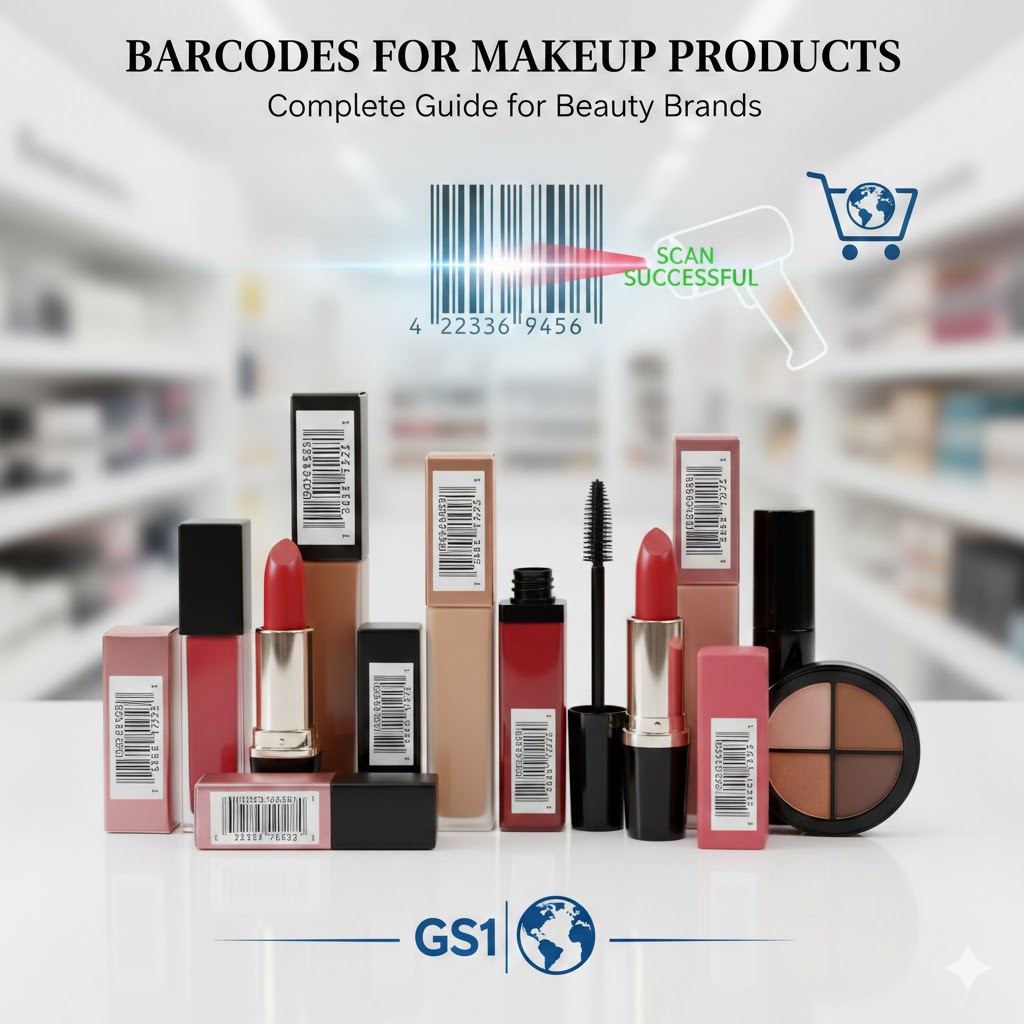
- Generate the correct barcode image.
- Place it on a suitable packaging surface.
- Maintain adequate clear space around it.
- Avoid excessive distortion.
- Maintain strong contrast.
- Print a real packaging sample.
- Scan the finished package.
A barcode that scans from a computer screen can still perform poorly after being printed on glossy, curved, metallic, or transparent packaging.
Verify Your Cosmetic Barcode Before Printing
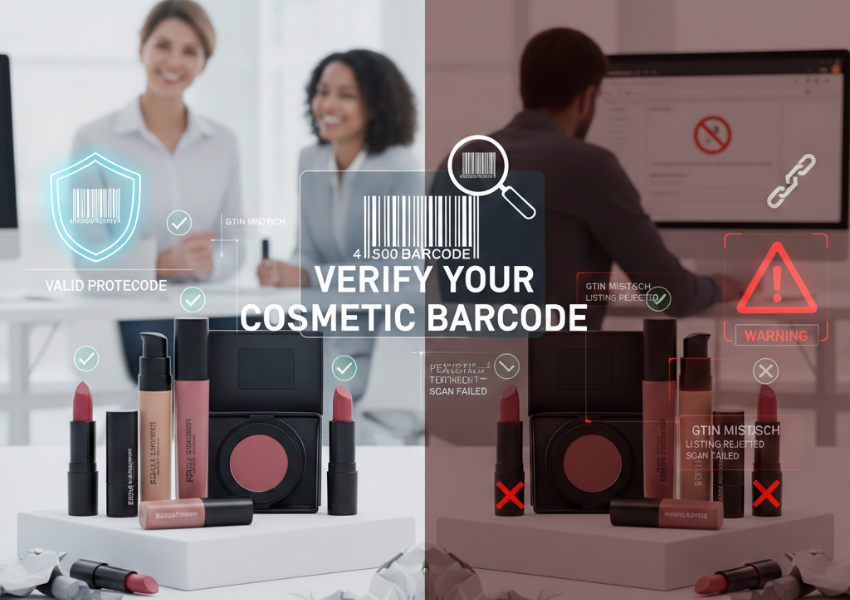
Before producing thousands of units, check the barcode itself.
Verification can include:
- Correct UPC/EAN number length
- Correct check digit
- Correct encoded number
- Digital scan test
- Physical printed scan
- Adequate quiet zones
- Appropriate contrast
- Product-to-barcode assignment
- Sales-channel requirements
If you're using a GS1-issued GTIN and need to check its GS1 information, use GS1's current Verified by GS1 service.
[INTERNAL LINK: Learn how to verify a cosmetic barcode → /blog/how-to-verify-if-a-cosmetic-barcode-is-valid-tools-step-by-step-process]
Common Amazon Cosmetic Barcode Mistakes
Buying Before Checking Amazon
Don't order a large barcode package solely because you assume Amazon requires it. Determine your listing requirements first.
Using One Identifier for Several Shades
Different lipstick shades or foundation tones are separate product variations and should normally be separately identified.
Confusing UPC/EAN With an Amazon FBA Barcode
These can serve different purposes. Check your FBA workflow to determine whether Amazon-specific labeling is required.
Assuming Every Third-Party Barcode Is GS1-Issued
A UPC/EAN number from another provider should not be described as a GS1-issued GTIN unless it actually is one.
Assuming Amazon Acceptance Is Permanent
Marketplace policies and listing requirements can change.
Printing Packaging Too Early
Resolve your product-ID and listing requirements before committing to large packaging runs.
Can You Sell Cosmetics on Amazon Without a GTIN?
Potentially, depending on the product and listing situation.
Amazon provides a GTIN-exemption process for eligible products that don't have product IDs.
Start through Amazon's product-listing workflow and indicate that the product doesn't have a product ID. Amazon can then determine whether the exemption option is available.
Do not assume eligibility before going through Amazon's process.
Do You Need Amazon Brand Registry to Sell Cosmetics?
Amazon Brand Registry and product identifiers are related to different parts of selling.
Brand Registry provides tools designed to help eligible brand owners manage and protect their brands on Amazon.
Having a barcode does not automatically enroll you in Brand Registry, and joining Brand Registry is not the same thing as obtaining a product identifier.
Treat these as separate processes and follow Amazon's current eligibility requirements for each.
Frequently Asked Questions
Does Amazon require UPC barcodes for cosmetics?
Amazon uses product IDs such as GTINs in its catalog, but the exact listing route can depend on the product. Existing catalog products, new products, and products eligible for GTIN exemption can follow different processes.
Does Amazon require GS1 for a new cosmetic brand?
Amazon's current public guidance says that if you create and own a new product and need a GTIN, you can obtain one through GS1. Check the current requirements presented for your specific listing before obtaining identifiers.
Can I use an EAN instead of a UPC?
UPC and EAN are both product-identification formats used internationally. Use the identifier accepted for your particular marketplace and listing rather than assuming based solely on geography.
Does every lipstick shade need its own identifier?
Different shades are separate product variations and should normally be separately identified.
Does every foundation shade need its own identifier?
Generally, yes. Separate shades represent distinct retail variations.
Can a cosmetic bundle use one of the individual product barcodes?
A bundle sold as a separate product should not simply reuse an individual component's identifier to represent the whole bundle.
Are GS1UPC barcodes GS1-issued?
No. GS1UPC does not represent its supplied UPC/EAN barcode numbers as GS1-issued GTINs or GS1 database registration.
Does GS1UPC guarantee Amazon acceptance?
No. Amazon requirements can vary and change. Customers have reported successful use, but sellers should check the requirements for their particular product, brand, category, marketplace, and account before purchasing.
Does an FBA cosmetic product need another barcode?
It can. Amazon's FBA requirements distinguish manufacturer barcodes from Amazon barcodes, and some product types require Amazon barcodes for inventory tracking. Check the current FBA requirements for your product before shipping inventory.
Amazon Cosmetics Barcode Checklist for 2026
Before listing or manufacturing large quantities of cosmetic packaging:
- Search Amazon's catalog for the product.
- Determine whether your new listing requires a GTIN.
- Check whether a GTIN exemption is available if you don't have a product ID.
- Identify every separate shade, size, fragrance, and product variation.
- Determine the appropriate product identifier.
- Check whether Amazon specifically requires a GS1-issued GTIN.
- Keep each product-to-barcode assignment documented.
- Determine whether FBA requires an Amazon barcode for your inventory.
- Test your finished printed barcode.
- Confirm current requirements before mass printing packaging.
Final Takeaway
There is no single “Amazon cosmetics barcode” that solves every identification and fulfillment requirement.
Cosmetic sellers need to distinguish between:
- The GTIN or product ID used for the Amazon catalog
- UPC/EAN barcode symbols used for product identification
- GTIN exemptions where Amazon makes them available
- Amazon barcodes used for certain FBA inventory
- Physical barcode print quality
- Separate identifiers for product variations
If Amazon specifically requires a GS1-issued GTIN for your new cosmetic product, follow that requirement.
If you have confirmed that GS1UPC's UPC or EAN barcode solution is suitable for your intended use, choose the number of barcodes according to the unique cosmetic products and variations you need to identify.
View UPC & EAN barcode packages
Always perform the Amazon requirement check before purchasing barcodes and before printing large quantities of cosmetic packaging.