Not all clothing products are labeled the same way. A barcode label that works perfectly for a folded T-shirt may fail completely on a padded winter jacket or a pair of socks. Each clothing category has unique packaging, handling, display, and durability requirements and barcode labeling must adapt accordingly.
This guide explains how barcodes for clothing should be applied across different apparel categories, helping clothing brands choose the right approach based on garment type, retail environment, and customer handling behavior.
Why Clothing Category Matters in Barcode Labeling
Clothing is not a uniform product category. Apparel varies in:
- Fabric thickness
- Folding style
- Packaging method
- Shelf display format
- Handling frequency
- Moisture exposure
- Price point
Because of these differences, barcode labeling must be customized per category. Applying a one size fits all labeling method often leads to scanning issues, label damage, or poor retail presentation.
Brands that adapt barcode labeling by clothing category reduce operational friction and improve retailer relationships.
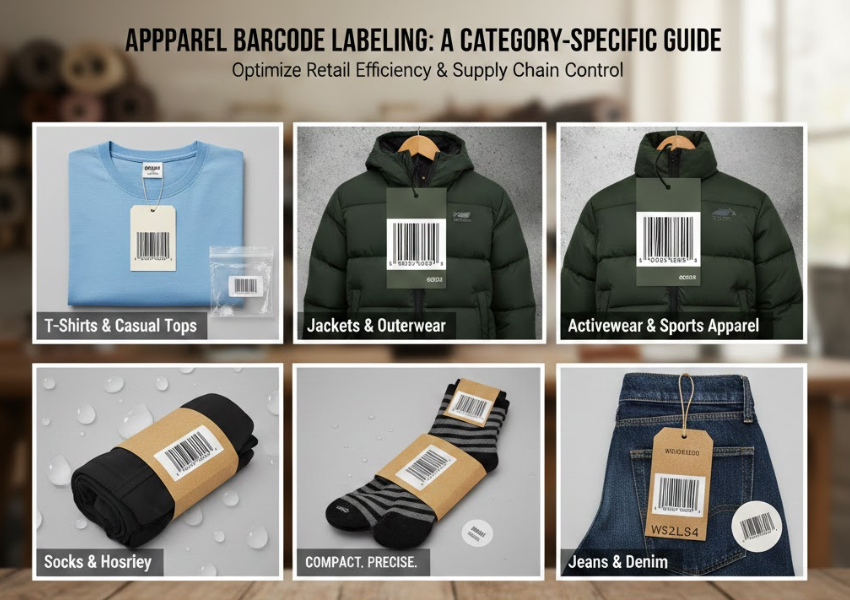
Barcode Labels for T Shirts and Casual Tops
T-shirts are among the most commonly sold apparel items. They are typically lightweight, folded, stacked, and frequently handled by customers.
- Back of the hang tag
- Packaging polybag (if sealed)
- Optional warehouse sticker for bulk handling
Label Considerations
T shirts are often stacked horizontally. If the barcode is placed where it bends during folding, scan reliability drops. The barcode must remain flat and visible when the shirt is folded for display.
Common Mistakes
- Placing barcode directly on fabric
- Using low-quality adhesive labels
- Printing barcodes too small to save space
For fast fashion and high volume T-shirt brands, durability is less critical than scan clarity and cost efficiency.
Barcode Labels for Jackets and Outerwear
Jackets, coats, and outerwear are bulkier and often displayed on hangers. They are handled less frequently but are exposed to heavier materials and sometimes moisture during shipping.
Best Barcode Placement
- Large hang tag attached to zipper or collar
- External packaging label (for warehouse use)
Label Considerations
Because jackets are thick and structured, barcode labels should never be placed on curved or padded surfaces. Hang tags provide a stable, flat scanning surface.
For premium jackets, synthetic or tear resistant label materials are recommended due to longer shelf life and higher price points.
Common Mistakes
- Using small tags that fold under garment weight
- Placing barcode inside inner lining
- Printing on glossy backgrounds that reflect scanners
Outerwear requires more durable labeling than lightweight apparel.
Barcode Labels for Activewear and Sports Apparel
Activewear often uses stretchable, moisture-resistant fabrics. These garments are tightly folded or compressed for retail display.
Best Barcode Placement
- Hang tag
- Packaging sleeve label
- External sticker for warehouse handling
Label Considerations
Activewear may be exposed to sweat, humidity, or compression. Barcode labels should use materials resistant to light moisture and friction.
For athletic brands with premium positioning, label durability reflects brand quality.
Common Mistakes
Using paper labels for long term display
Allowing barcodes to bend with elastic fabric
Printing with low contrast
Durability and readability should be balanced carefully in this category.
Barcode Labels for Socks and Hosiery
Socks are typically sold in bundles or compact packaging. They are frequently handled and stacked in bins or shelves.
Best Barcode Placement
- Cardboard sleeve
- Packaging wrap
- Rear cardboard header
Label Considerations
Since socks are compact, barcodes must be placed where they remain flat and accessible without opening packaging.
Small packaging requires careful barcode sizing to maintain scanner accuracy.
Common Mistakes
- Over compressing barcode size
- Placing barcode on curved elastic area
- Using adhesive labels that peel easily
Socks require compact but precise labeling.
Barcode Labels for Jeans and Denim
Denim is heavier and often folded thickly. Jeans are displayed both stacked and hanging.
Best Barcode Placement
- Durable hang tag
- Waistband loop tag
- Packaging label for warehouse distribution
Label Considerations
Denim garments are thicker and more rigid, which can cause small tags to bend or twist. Using reinforced hang tags prevents barcode distortion.
Since denim often has multiple size variations (waist x length), each variation must have a unique barcode clearly matched to its SKU.
Common Mistakes
- Mixing size barcodes
- Placing labels under folded waistband
- Inconsistent tag placement across batches
Consistency is critical in denim labeling due to high variation complexity.
Barcode Labels for Fashion Accessories
Accessories such as belts, scarves, hats, and gloves require different labeling logic.
Best Barcode Placement
- Attached swing tag
- Product card backing
- Packaging sticker
Label Considerations
Accessories often have limited flat surfaces. Barcodes should be placed on rigid tags or packaging, not directly on soft materials.
Because accessories may be smaller, label size planning becomes important.
Common Mistakes
- Printing barcodes too small
- Using removable labels that detach easily
- Covering barcode with pricing stickers
Accessories demand careful size to space balance.
Barcode Labels for Luxury and Premium Apparel
Luxury garments require barcode placement that does not interfere with aesthetic presentation.
Best Barcode Placement
- Discreet hang tag
- Secondary packaging label
Label Considerations
High end brands prioritize design and presentation. Barcodes must be visible for scanning but not visually disruptive.
Synthetic, high-quality label materials are preferred to match premium branding standards.
Category Specific Barcode Variation Management
Each clothing category may contain multiple variations:
- Size
- Color
- Fabric composition
- Seasonal collection
Every variation requires its own gs1 barcode. This is especially critical for:
- Denim sizing combinations
- Multi color activewear
- Bundled sock packs
Incorrect variation management leads to inventory mismatches and customer dissatisfaction.
Retail vs E-Commerce Labeling Differences
Some clothing categories require slightly different barcode strategies depending on the sales channel.
Retail Stores
- Visible hang tags
- Fast POS scanning
- Customer handling durability
E-Commerce
- Packaging labels
- Warehouse scan reliability
- Shipping durability
Brands selling both online and offline should design barcode systems that serve both channels effectively.
Trending Considerations in Apparel Barcode Labeling
Clothing brands increasingly focus on:
- Sustainability labeling
- Smart packaging
- Multi channel inventory systems
- Faster checkout technology
While traditional retail barcodes remain essential, brands must ensure compatibility with modern retail environments.
However, foundational barcode clarity and proper placement remain the top priority.
Common Cross Category Mistakes Brands Should Avoid
Across all apparel categories, these errors frequently occur:
- Reusing barcodes across variations
- Ignoring packaging format
- Placing barcodes where folding damages them
- Using poor quality printing
- Inconsistent placement across product lines
Avoiding these issues improves operational stability.
Final Thoughts Why Category Specific Barcode Strategy Matters
Clothing Barcode labels are not just compliance tools, they are operational assets. Different clothing categories present unique physical and retail challenges. A thoughtful labeling strategy based on garment type improves:
- Retail efficiency
- Inventory accuracy
- Checkout speed
- Brand professionalism
- Scalability
Clothing brands that align barcode labeling with product categories gain smoother retail integration and stronger supply chain control.
Frequently Asked Questions:
Question: What are the different types of barcodes for clothing?
Answer: Garment barcodes play a key role in inventory correction, stock control, and retail efficiency. Different types of barcodes like UPC, EAN 13, Code 128, and QR codes serve specific garment industry needs. Barcode systems improve speed at checkout, product traceability, and supply chain visibility.
Question: How to choose a barcode type?
Answer: Decide between 1D and 2D barcodes based on data capacity and application requirements. Select Scanners: Choose compatible scanners, whether handheld barcode scanners for mobility or wired barcode scanners for large numbers of scanning.
Question: What are the 5 basic care labels?
Answer: The new standard is harmonized with the American and international standards for care labeling using five basic symbols which must appear in the sequence: washing, bleaching, drying, ironing, professional textile care.