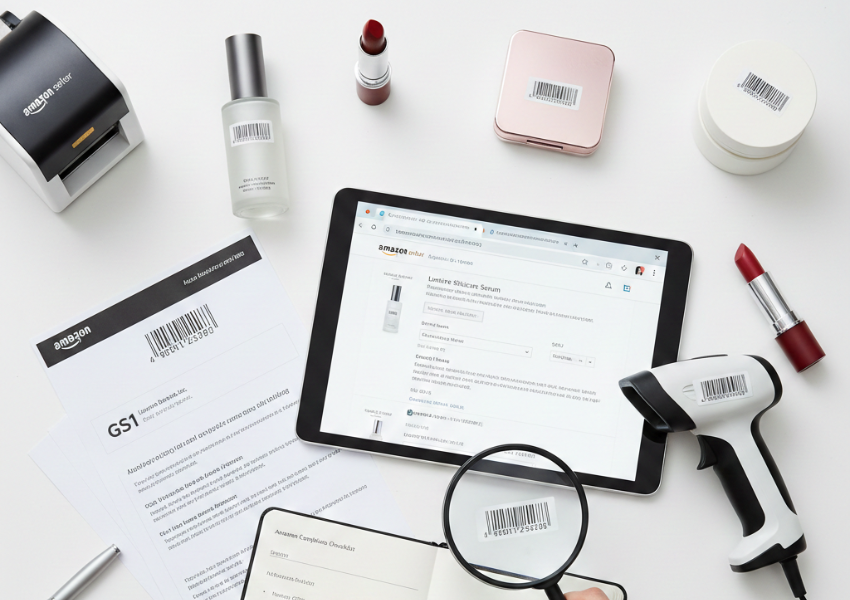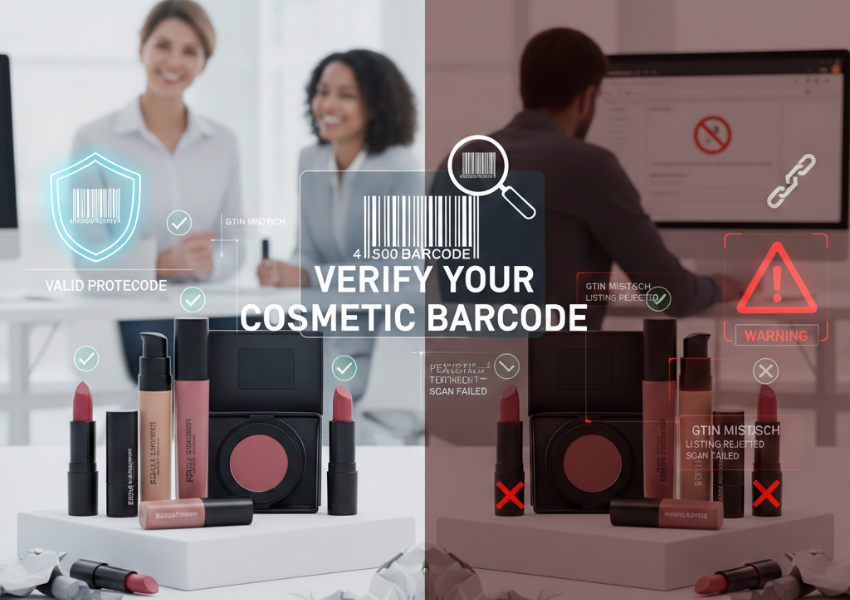
Before printing thousands of lipstick boxes, skincare labels, perfume cartons, or other cosmetic packaging, it is worth checking your barcode carefully.
But what does a “valid barcode” actually mean?
A barcode can have a mathematically correct number and still be poorly printed. It can also be technically readable while not meeting the requirements of a particular marketplace.
For cosmetic brands, barcode verification should therefore involve several separate checks rather than relying on a single online lookup.
This guide explains how to check the barcode number, barcode image, physical print quality, product assignment, GS1 information when applicable, and marketplace requirements.
What Does It Mean for a Cosmetic Barcode to Be Valid?
There is no single test that answers every barcode question.
For practical purposes, cosmetic brands should consider at least these areas:
- Number structure – Is the UPC or EAN correctly formatted and does its check digit calculate correctly?
- Barcode symbol – Does the barcode image correctly encode the intended number?
- Print and scan quality – Can the physical barcode be reliably scanned?
- Product assignment – Has the number been assigned consistently to one specific product or variation within your product records?
- GS1 verification, when applicable – If the number is claimed to be a GS1-issued GTIN, does GS1's database return the expected information?
- Sales-channel acceptance – Does the retailer or marketplace where you intend to sell accept the identifier for your particular product and account?
Passing one of these checks does not automatically prove all the others.
Step 1: Check the UPC or EAN Number Structure
Start with the digits themselves.
UPC-A normally contains 12 digits, while EAN-13 contains 13 digits.
The final digit is known as a check digit. It is calculated mathematically from the preceding digits and helps systems detect certain data-entry and scanning errors.
If the check digit is incorrect, the number has a structural problem.
You can use a check-digit calculator to confirm whether the final digit is mathematically correct.
However, this is important:
A correct check digit does not prove marketplace acceptance, GS1 registration, ownership, or product identity.
It only confirms that the check digit is consistent with the preceding digits.
Step 2: Scan the Barcode Image
Next, test the actual barcode image.
Use a barcode scanner or suitable scanning application and confirm that the decoded number exactly matches the number printed underneath the barcode.
For example, if the human-readable UPC number is:
123456789012
the scanner should return the same number.
If it returns a different number or cannot read the symbol reliably, investigate the barcode image before using it on packaging.
Testing the digital image is useful, but don't stop there.
The final printed package can behave differently from an image displayed on a computer screen.
Step 3: Test the Physical Printed Barcode
A barcode that scans perfectly from a PDF or JPG can still fail after being printed.
Cosmetic packaging can be particularly challenging because it often includes:
- Small containers
- Curved surfaces
- Glossy materials
- Metallic finishes
- Transparent labels
- Decorative backgrounds
- Foil
- Seams and folds
Print a production-size sample and test the actual packaging before ordering a large quantity.
Check whether the barcode scans consistently and whether the bars remain clear and undistorted.
Step 4: Check Barcode Contrast and Quiet Zones
Barcode readability depends on more than the number.
The symbol needs adequate contrast between its bars and background, appropriate dimensions, and sufficient clear space around it.
The blank areas to the left and right of many linear barcodes are known as quiet zones. They help scanning equipment distinguish the barcode from surrounding graphics and text.
For reliable results:
- Maintain strong contrast.
- Avoid putting text or graphics inside required clear areas.
- Do not stretch the barcode disproportionately.
- Avoid placing it across packaging seams.
- Be careful with highly reflective or transparent materials.
- Test the barcode at its final printed size.
A normal scanner can tell you whether that particular scanner can read the symbol. Professional barcode verification goes further by measuring barcode quality against applicable technical standards.
Step 5: Confirm the Barcode Is Assigned to the Correct Cosmetic Product
Technical readability is only one part of barcode management.
You should also confirm that your internal product records assign the barcode to the correct product.
For example:
Barcode: 123456789012
Product: Matte Lipstick
Shade: Ruby Red
Size: 4 g
SKU: LIP-RR-04
Don't assign that same number to a different shade or unrelated product in your catalog.
Maintain a spreadsheet or product database containing fields such as:
Product Name | SKU | Shade | Size | UPC/EAN | Sales Channel
This becomes increasingly important as a beauty brand expands its product range.
Step 6: Check Every Cosmetic Variation
Cosmetics frequently have multiple variations that need to be separately identified.
Examples include:
- Lipstick shades
- Foundation tones
- Fragrances
- Bottle sizes
- Product volumes
- Pack quantities
- Gift sets
- Bundles
For example, if a foundation is available in 15 shades, those shades are separate retail variations and would normally be assigned separate product identifiers rather than all sharing one barcode.
Before launch, compare your barcode list against your complete product catalog and make sure you haven't accidentally duplicated an assignment.
Step 7: Use Verified by GS1 When Checking a GS1-Issued GTIN
If your barcode number is supposed to be a GS1-issued GTIN, you can check it using GS1's official lookup service, Verified by GS1.
Verified by GS1 can provide information about the company, organization, or person that assigned a GS1 GTIN and may also provide available product information.
This is useful when you specifically need to answer questions such as:
- Is this number found in the GS1 system?
- Who is associated with the GS1 GTIN?
- Is product information available for it?
There is an important limitation:
Verified by GS1 is a verification service for identifiers within the GS1 system.
A barcode number not appearing there should not automatically be described as mathematically invalid, unscannable, or unusable for every possible application. Those are separate questions.
Likewise, a number appearing in Verified by GS1 does not replace checking the specific requirements of the marketplace or retailer where you intend to sell.
What Happened to GS1 GEPIR?
Older barcode guides may tell you to search the GEPIR database.
That information is outdated.
GS1 replaced GEPIR with Verified by GS1. Therefore, businesses checking current GS1 GTIN information should use the current Verified by GS1 service rather than relying on old GEPIR instructions.
Step 8: Check Your Marketplace or Retailer's Requirements Separately
Marketplace acceptance is another separate check.
A barcode can:
- Have a correct check digit
- Scan successfully
- Be clearly printed
and still not satisfy a marketplace's product-identification requirements.
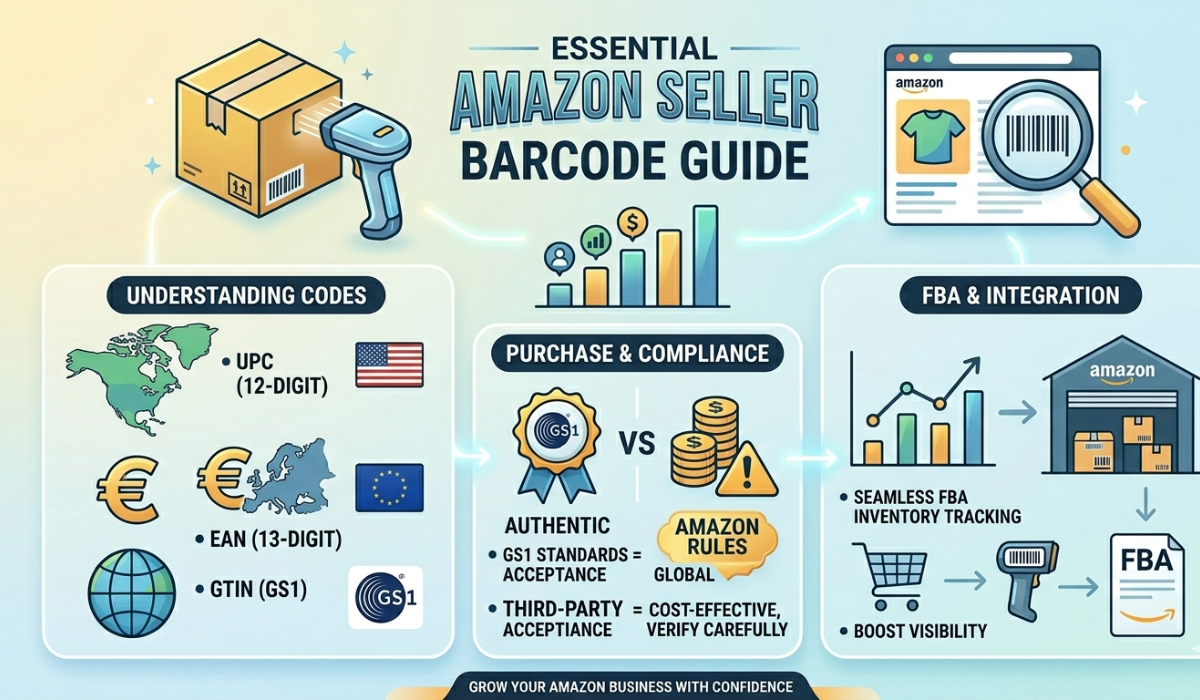
Amazon, Walmart, retailers, distributors, and other sales channels can have their own policies. Requirements can also vary according to product category, brand, country, seller account, and listing situation.
Therefore, don't treat a successful barcode scan as proof that a marketplace will accept the identifier.
Check the current requirements of your intended sales channel before printing large quantities of packaging.
[INTERNAL LINK: Amazon cosmetic barcode requirements → /blog/what-barcode-requirements-are-needed-to-sell-cosmetics-on-amazon-in-2026]
How to Verify a Barcode Before Selling on Amazon
If Amazon is your intended marketplace, perform two separate checks.
First, verify the technical quality of the barcode itself: number structure, barcode image, physical printing, and product assignment.
Second, check Amazon's current product-ID requirements for your particular listing.
Amazon uses product IDs such as GTINs to identify products and match offers with catalog entries. Requirements can vary, and some products may follow different listing processes or potentially qualify for a GTIN exemption.
Do not assume that passing a checksum or scanning successfully guarantees Amazon acceptance.
Similarly, do not assume that past acceptance of another barcode guarantees acceptance of every future listing.
How to Check a Barcode Purchased from GS1UPC
GS1UPC supplies UPC and EAN barcode numbers through its own controlled barcode-generation and database system.
If you purchased barcodes from GS1UPC, you can perform several practical checks before using them:
- Confirm the number in your delivered Excel file.
- Scan the supplied barcode image.
- Make sure the scanned digits match the delivered number.
- Confirm that you assign each supplied number to only one product or variation within your catalog.
- Print a sample at the intended packaging size.
- Test the finished printed barcode before mass production.
- Check the requirements of the retailer or marketplace where you intend to use it.
GS1UPC's system is designed to prevent duplicate barcode numbers within its own inventory, and records are managed so that the same number is not intentionally or accidently allocated to multiple customers.
Customers also receive a Certificate of Ownership for the supplied barcode range as part of their delivered package.
Will a GS1UPC Barcode Appear in Verified by GS1?
You should not expect a barcode supplied by GS1UPC to appear as a GS1-issued GTIN registered to your company simply because you purchased it from GS1UPC.
GS1UPC does not represent its barcode numbers as GS1-issued GTINs, GS1 membership, or GS1 database registration.
If your retailer or marketplace specifically requires a GS1-issued GTIN associated with your company, obtain the identifier through the appropriate GS1 organization.
If your intended sales channel accepts the UPC or EAN barcode solution offered by GS1UPC, you can use the verification steps in this guide to check number structure, scanning, printing, product assignment, and the requirements of that sales channel.
Barcode Scanner vs Barcode Verifier: What's the Difference?
These terms are often confused.
A barcode scanner reads the information encoded in a barcode. It can help confirm that a symbol can be read by that particular scanning setup.
A barcode verifier performs a more detailed assessment of barcode quality. Professional verification equipment can evaluate characteristics such as symbol contrast, dimensions, quiet zones, and other print-quality parameters against applicable standards.
Therefore:
Scanner test: “Can this device read my barcode?”
Professional verification: “How well does this printed symbol meet defined quality requirements?”
For businesses producing large quantities of retail packaging, professional barcode verification may be worth discussing with the packaging printer or labeling provider.
Does a Correct Check Digit Mean a Barcode Is Valid?
It proves something much narrower.
A correct check digit confirms that the final digit is mathematically consistent with the preceding digits according to the relevant calculation.
It does not, by itself, prove:
- GS1 registration
- Ownership
- Product assignment
- Marketplace acceptance
- Retailer acceptance
- Print quality
Think of checksum validation as one component of barcode checking rather than a universal validity test.
Common Cosmetic Barcode Problems
The Barcode Won't Scan
Possible causes include poor contrast, inadequate clear space, distortion, incorrect dimensions, printing problems, reflective packaging, or damage.
The Barcode Scans to the Wrong Number
Compare the encoded data with your source barcode number and regenerate or correct the artwork before printing.
The Same Barcode Was Assigned to Two Products
Correct your internal product assignment before distributing the products. Each separately identified product or variation should normally have its own assigned number.
A Marketplace Rejects the Product ID
Check the marketplace's current error message and product-ID requirements. Don't assume that a technically readable barcode automatically satisfies the platform's catalog rules.
Verified by GS1 Doesn't Find the Number
First determine what kind of identifier you are checking.
If the number was represented as a GS1-issued GTIN, investigate its GS1 status through the appropriate GS1 channels.
If the number came from another barcode source, absence from Verified by GS1 should not be confused with failure of a checksum or physical scan test. However, it may matter significantly if your retailer or marketplace specifically requires GS1-issued identifiers.
Frequently Asked Questions
How do I check whether my cosmetic barcode scans correctly?
Scan both the digital barcode and a sample printed on the actual packaging. Confirm that the decoded digits exactly match the intended barcode number.
How can I check the barcode check digit?
Use a suitable UPC/EAN or GTIN check-digit calculator. The check digit confirms the mathematical structure of the number but does not establish marketplace acceptance or ownership.
How do I check a GS1-issued GTIN?
Use Verified by GS1, GS1's current official lookup service for checking identifiers within its system.
Is GEPIR still the current GS1 lookup tool?
No. GEPIR has been replaced by Verified by GS1.
Does a barcode have to appear in Verified by GS1 to scan?
These are different checks. Scanning tests whether a barcode symbol can be read and decoded. Verified by GS1 checks identifiers within the GS1 system.
Whether GS1 registration is required for your business use depends on the requirements of your retailer, marketplace, distributor, or other trading partner.
Can two lipstick shades use the same barcode?
Different shades are normally treated as separate product variations and should be separately identified.
Does a successful scan guarantee Amazon acceptance?
No. Technical scanning and Amazon product-ID acceptance are different issues. Check Amazon's current requirements for your particular product and seller situation.
Does GS1UPC guarantee marketplace acceptance?
No. Requirements can differ between marketplaces, categories, brands, accounts, and countries and can change over time. Verify the requirements of your intended sales channel before purchasing or printing packaging.
Cosmetic Barcode Verification Checklist
Before approving your packaging for production, check:
- UPC/EAN number length
- Check digit
- Encoded barcode number
- Digital scan
- Printed scan
- Barcode dimensions
- Quiet zones
- Print contrast
- Packaging surface
- Product-to-barcode assignment
- Unique assignment for relevant variations
- GS1 database information if a GS1-issued GTIN is required
- Marketplace or retailer requirements
Only after these checks should you proceed confidently with large-scale packaging production.
Final Takeaway
Barcode verification is not one single lookup.
For cosmetic brands, a thorough process checks the number, barcode symbol, physical print quality, product assignment, applicable database information, and sales-channel requirements.
If you're using a GS1-issued GTIN, Verified by GS1 is the appropriate service for checking information within the GS1 system. If you're testing barcode readability, scan and preferably verify the actual printed symbol. If you're preparing for Amazon or another marketplace, check that marketplace's current product-ID requirements separately.
Keeping these checks separate gives cosmetic businesses a much clearer picture of whether their barcode is ready for its intended use.
If you have confirmed that GS1UPC's UPC or EAN barcode solution meets your intended requirements, you can choose barcode packages according to the number of cosmetic products and variations you need to identify.