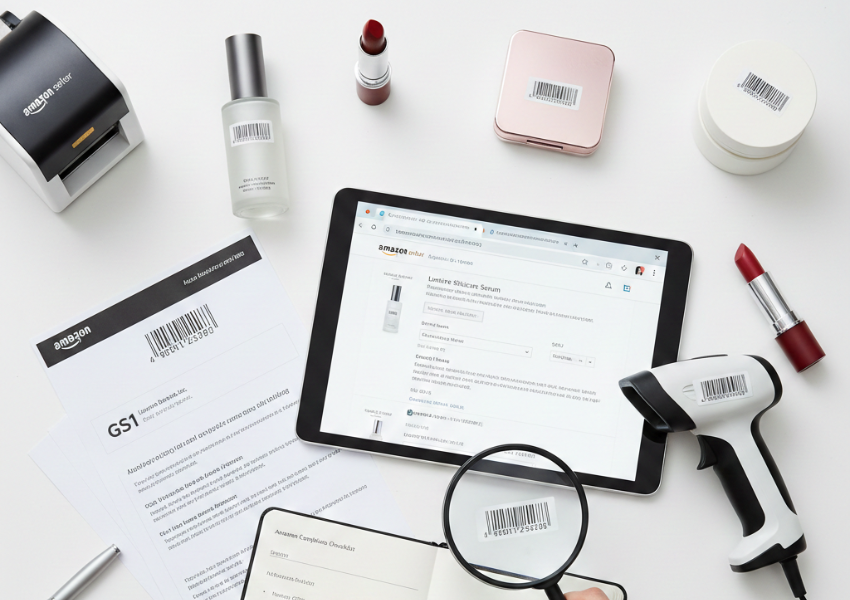
GS1 maintains global standards for product identification, but the exact barcode or GTIN requirements that apply to your cosmetic product depend on where and how you intend to sell it.
Before purchasing barcode numbers, cosmetic brands should therefore understand their product variations, target market, retailer requirements, and marketplace requirements.
What Is GS1 and What Does It Have to Do With Barcodes?
GS1 is an international standards organization responsible for a system of identification standards used throughout retail and supply chains.
One of the most important identifiers within the GS1 system is the GTIN, or Global Trade Item Number.
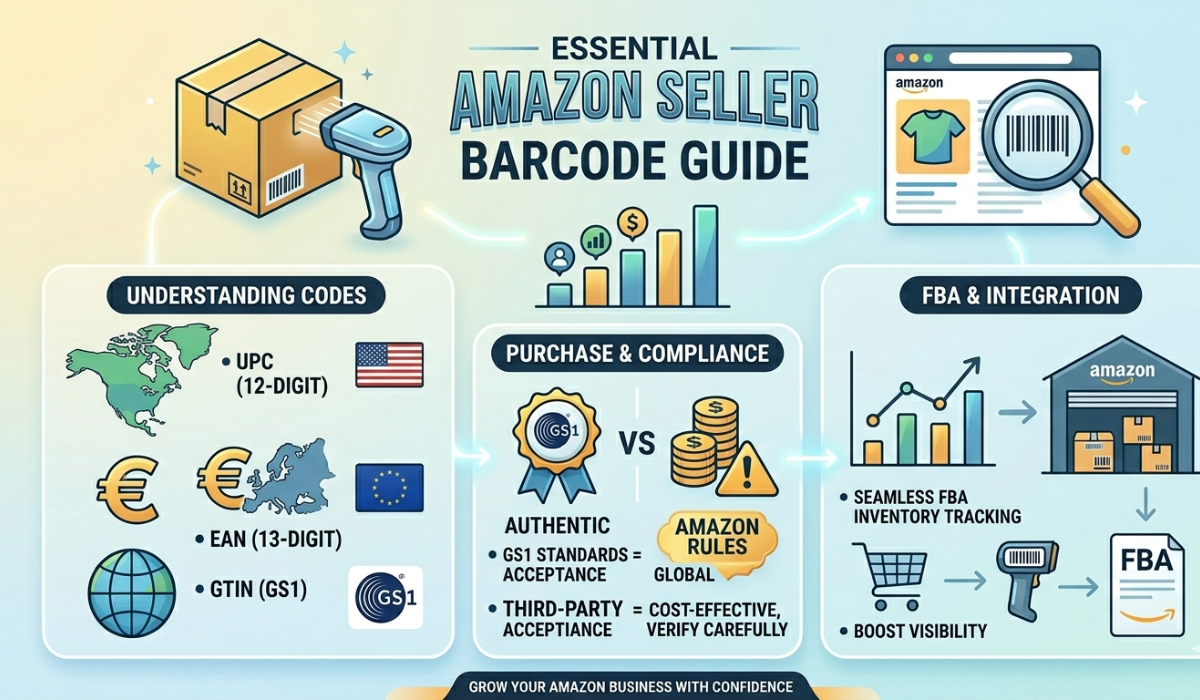
Common GTIN formats include:
- GTIN-12, commonly associated with UPC
- GTIN-13, commonly associated with EAN
- GTIN-8 for certain smaller items
- GTIN-14 for certain packaging and distribution applications
The barcode is the machine-readable symbol that carries an identifier so it can be scanned.
For cosmetic businesses, this distinction matters because a retailer asking for a UPC or EAN barcode is not necessarily making exactly the same request as a marketplace specifically requiring a GS1-issued or verified GTIN.
Always check the exact requirement of the business or platform where you intend to sell.
Do Cosmetic Products Legally Require GS1 Barcodes?
There is no universal rule that every cosmetic product must have a GS1-issued barcode simply because it is a cosmetic.
Barcode requirements and cosmetic-labeling laws are separate issues.
A retailer, distributor, marketplace, or other trading partner may require a product identifier before accepting or listing your product. Their requirements may specify a particular identifier or source.
Cosmetic-labeling laws, meanwhile, can require completely different information on the package.
For example, cosmetic products marketed to consumers in the United States are subject to FDA labeling requirements covering information such as product identity, net quantity of contents, business information, ingredients, and applicable warnings.
A barcode does not replace these labeling requirements.
Therefore, cosmetic businesses should check both:
- The legal labeling requirements applicable in the country where the cosmetic is sold.
- The barcode and product-identification requirements of the retailer, distributor, or marketplace.
UPC and EAN Barcodes for Cosmetic Products
UPC-A and EAN-13 are among the most familiar barcode formats used on retail products.
UPC-A Barcodes
UPC-A contains 12 digits and is commonly encountered in North American retail, particularly in the United States and Canada.
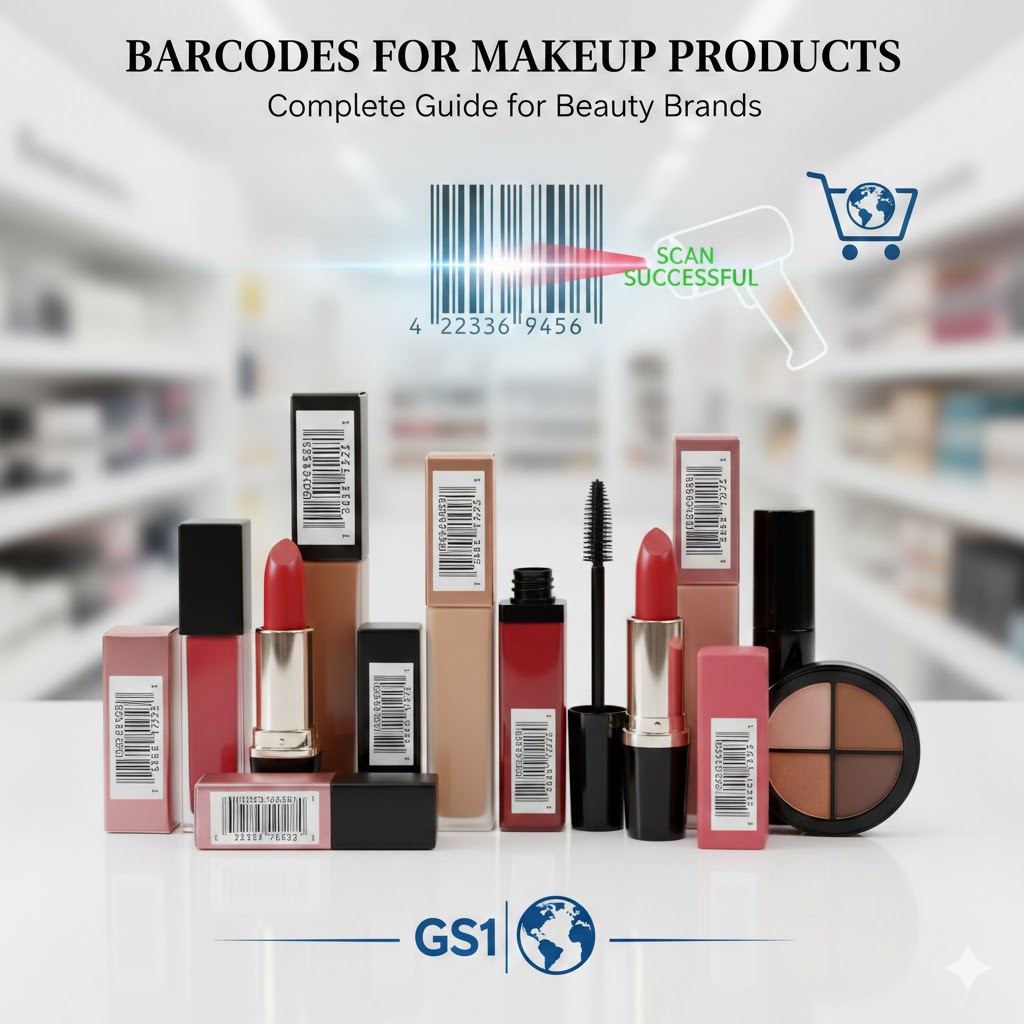
Cosmetic products that may use UPC barcodes include:
- Lipstick
- Foundation
- Mascara
- Face creams
- Serums
- Shampoo
- Perfume
- Makeup accessories
- Skincare products
EAN-13 Barcodes
EAN-13 contains 13 digits and is commonly encountered across Europe and many other international retail markets.
Both formats are designed to provide machine-readable product identification at retail.
The correct format for your cosmetic product should be based on the requirements of your intended retailer, marketplace, distributor, or other sales channel rather than simply assuming that one format is required everywhere.
Does Every Cosmetic Variation Need a Different Barcode?
This is particularly important for beauty brands because cosmetics often have many variations.
In general, separately identifiable products and variations should have their own product identifiers.
Consider a lipstick available in six shades:
- Ruby Red
- Rose Pink
- Nude Beige
- Berry
- Coral
- Plum
These are six separately identifiable products from an inventory and retail perspective, so they would normally be assigned separate identifiers rather than sharing one barcode.
The same principle commonly applies to different:
- Shades and colors
- Sizes
- Volumes
- Fragrances
- Pack quantities
- Product types
- Sets and bundles
For example, a 30 ml face serum and a 50 ml version should not automatically be treated as the same trade item simply because the formulation is similar.
Count all of your individual cosmetic products and variations before deciding how many barcode numbers you need.
Cosmetic Sets, Gift Packs and Bundles
Beauty businesses frequently create combinations such as:
- Skincare gift sets
- Lipstick collections
- Shampoo and conditioner packs
- Makeup kits
- Perfume sets
- Promotional beauty boxes
If a combination is sold as a distinct retail product, it may need identification separate from the individual products inside it.
For example, a skincare set containing a cleanser, serum, and moisturizer can be a separate sellable item even when the three individual products already have their own barcode numbers.
This is another reason cosmetic businesses should map their entire product catalog before purchasing barcodes.
How Many Barcodes Does a Cosmetic Brand Need?
Start by counting every separately sold product and variation.
Imagine a beauty company has:
Lipstick
- 8 shades
Foundation
- 10 shades
Face Serum
- 30 ml
- 50 ml
Gift Set
- 1 configuration
The company would have 21 separately identifiable products or variations in this example. For large size inventory use GS1UPC Barcodes Estimator
Creating a simple spreadsheet before purchasing barcode numbers can make this much easier.
Useful columns include:
Product Name | SKU | Shade | Size | Barcode Number | Sales Channel
This also helps prevent accidentally assigning the same number to multiple products within your own catalog.
Buying UPC and EAN Barcodes for Cosmetics
If you have confirmed that UPC or EAN barcodes from a third-party barcode provider are suitable for your intended sales channel, you can select barcode numbers according to the number of cosmetic products and variations you need to identify.
GS1UPC supplies UPC and EAN barcode packages for businesses that need barcode numbers for their products.
After successful payment, GS1UPC customers receive:
- Scannable barcode files in PDF and JPG formats
- An Excel file containing the supplied barcode numbers
- A Certificate of Ownership for the supplied barcode range
GS1UPC uses a controlled barcode-generation and database system designed to prevent duplicate barcode numbers within its inventory. Barcode records are managed within the system so that the same number is not intentionally or accidently allocated to multiple customers.
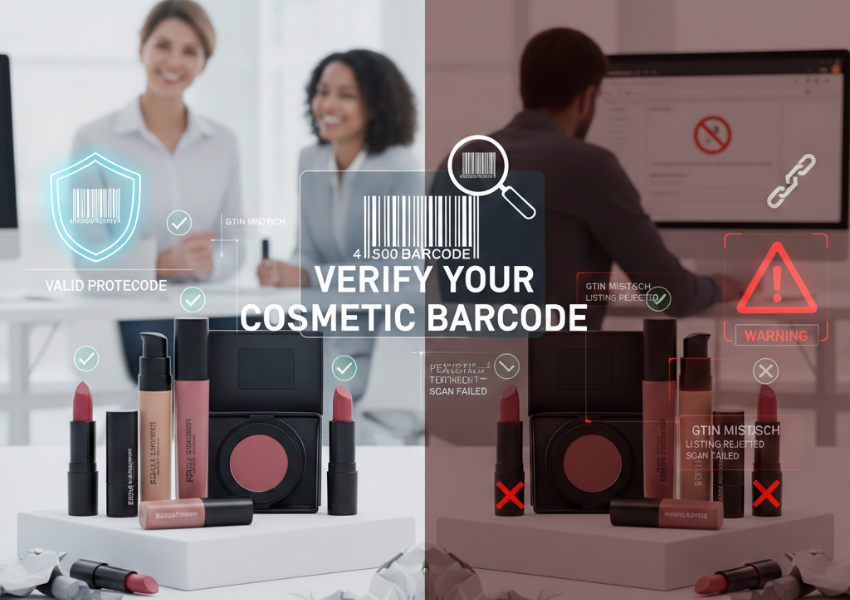
Before purchasing, verify that this type of barcode solution meets the requirements of your intended retailer, marketplace, distributor, or other trading partner.
Are GS1UPC Barcodes GS1-Issued Barcodes?
No.
This distinction should be understood before purchasing.
Barcode numbers supplied by GS1UPC should not be represented as GS1-issued GTINs, GS1 membership, GS1 certification, or GS1 database registration.
If a retailer or marketplace specifically requires a GS1-issued GTIN associated with your business, follow that requirement and obtain the identifier through the appropriate GS1 organization.
If your sales channel accepts the UPC or EAN barcode solution offered by GS1UPC, you can choose a package according to the number of products you need to identify.
Being clear about this difference helps businesses choose the appropriate barcode source before spending money or printing product packaging.
Can GS1UPC Barcodes Be Used on Amazon?
Marketplace requirements can change and may differ according to product, category, brand, seller account, and marketplace.
GS1UPC customers have reported successful use of purchased barcodes on platforms including Amazon, Walmart, and Shopify. However, past customer experience does not guarantee that a barcode will be accepted for every future listing or seller.
If you plan to sell cosmetics on Amazon, check Amazon's current product-ID requirements for your specific product and account before purchasing. Read our Amazon cosmetic barcode guide
This is especially important before printing large quantities of packaging.
Where Should a Barcode Be Placed on Cosmetic Packaging?
A good barcode is only useful if scanners can read it reliably.
Cosmetic packaging creates some unusual challenges because products can be small, curved, glossy, or irregularly shaped.
When possible:
- Use a reasonably flat surface.
- Keep sufficient clear space around the barcode.
- Maintain strong contrast between the bars and background.
- Avoid placing the barcode across seams or folds.
- Avoid stretching or distorting the barcode artwork.
- Test the finished printed barcode before mass production.
For products such as lipstick tubes, mascara, eyeliner, and other small packages, available label space may be limited. The appropriate barcode format and label design should therefore be considered before packaging is finalized.
Barcode Identification Is Not the Same as Cosmetic Label Compliance
This distinction deserves special attention.
A UPC or EAN barcode identifies a product for inventory, retail, and supply-chain purposes. It does not by itself make a cosmetic label legally compliant.
For example, U.S. cosmetic labeling requirements can cover matters including:
- Product identity
- Net quantity of contents
- Name and place of business
- Ingredient declaration
- Required warnings or cautions
Requirements differ between jurisdictions, so a cosmetic company selling internationally should check the regulations applicable in each target market.
Don't treat a barcode provider as a substitute for regulatory labeling advice.
Common Barcode Mistakes Cosmetic Brands Should Avoid
Using One Barcode for Several Shades
A lipstick or foundation line may look like one product family, but individual shades are separate retail variations and should normally be separately identified.
Buying Before Checking the Sales Channel
Don't purchase hundreds of barcode numbers first and ask whether your intended retailer accepts them afterward.
Check the retailer or marketplace requirements before purchasing.
Confusing UPC/EAN With GS1 Membership
UPC, EAN, GTIN, barcode symbols, GS1-issued identifiers, and GS1 membership are related concepts but are not interchangeable terms.
Assuming Marketplace Acceptance Is Guaranteed
No independent barcode provider should be treated as a guarantee of acceptance by every marketplace indefinitely. Requirements can change.
Reassigning Numbers Without Proper Records
Maintain a permanent product-to-barcode record so your team knows exactly which identifier has been assigned to each cosmetic product.
Printing Packaging Before Testing
Test the final barcode on the actual packaging material before ordering large print quantities.
Frequently Asked Questions
What type of barcode is commonly used for cosmetics?
UPC-A and EAN-13 are commonly used for retail products, including cosmetics. The appropriate format depends on your intended retailer, marketplace, distributor, and target market.
Do different lipstick shades need different barcodes?
Generally, yes. Different shades are separately identifiable product variations and should normally have separate product identifiers.
Do different sizes of the same skincare product need separate barcodes?
Generally, yes. A 30 ml and 50 ml version are different retail trade items and should normally be separately identified.
Is a barcode legally required on every cosmetic product?
Not universally. Legal cosmetic-labeling requirements and commercial barcode requirements are different. A retailer, distributor, or marketplace may require a barcode even where the applicable cosmetic law does not specifically require one.
Does a UPC or EAN barcode make my cosmetic FDA compliant?
No. A barcode is a product-identification tool. U.S. FDA cosmetic-labeling requirements cover other information such as product identity, net quantity, business information, ingredient declarations, and applicable warnings.
Does GS1UPC provide GS1-issued GTINs?
No. GS1UPC supplies its own UPC and EAN barcode solution. If your retailer or marketplace specifically requires a GS1-issued GTIN, obtain it through the appropriate GS1 organization.
Are GS1UPC barcodes guaranteed to work on Amazon?
No universal marketplace acceptance should be assumed. Customers have reported successful use on Amazon and other platforms, but requirements can vary and change. Check Amazon's current requirements for your product, category, brand, marketplace, and seller account before purchasing.
What do I receive when I purchase barcodes from GS1UPC?
After successful payment, GS1UPC provides scannable PDF and JPG barcode files, an Excel file containing the supplied barcode numbers, and a Certificate of Ownership for the supplied barcode range.
Final Checklist for Cosmetic Brands
Before purchasing barcode numbers for cosmetics:
- List every product and variation you intend to sell.
- Count different shades, sizes, volumes, fragrances, and pack configurations separately where appropriate.
- Identify the countries and sales channels where the products will be sold.
- Check the barcode or GTIN requirements of each important retailer or marketplace.
- Determine whether you specifically need GS1-issued identifiers or whether another UPC/EAN solution is suitable.
- Purchase the quantity you actually need.
- Maintain a product-to-barcode assignment record.
- Test your barcode on the finished packaging before mass printing.
- Separately verify the legal cosmetic-labeling requirements for your target market.
Final Takeaway
Barcode requirements for cosmetic products are easier to manage when three different issues are kept separate: product identification, marketplace requirements, and legal cosmetic labeling.
UPC and EAN barcodes can help businesses identify lipstick, skincare, makeup, fragrances, beauty sets, and other products throughout retail and inventory workflows. Different products and meaningful variations should be assigned appropriately so that each item can be distinguished.
But don't assume that every cosmetic needs a GS1-issued barcode or that every UPC/EAN source will satisfy every retailer or marketplace.
Check your sales-channel requirements first. Then choose the barcode solution that fits your products and intended use.
If you have confirmed that GS1UPC's UPC or EAN barcode solution is suitable for your products, you can select a package based on the number of unique cosmetic products and variations you need to identify.