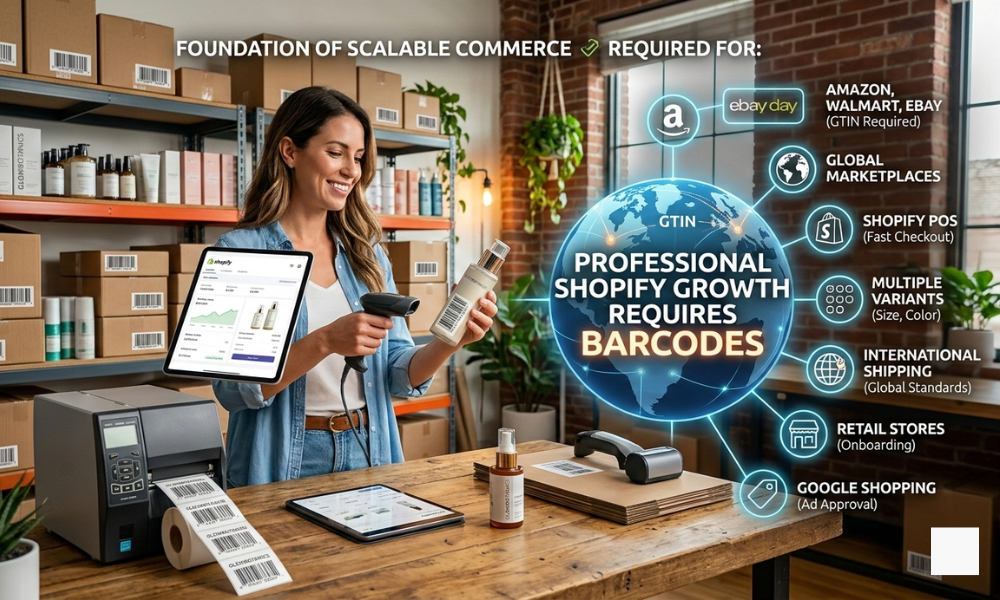
Building a professional ecommerce business on Shopify requires more than just product photos and pricing. As your store grows, product identification becomes critical for inventory control, marketplace expansion, retail distribution, and brand protection.
For serious sellers, barcodes are not just numbers they are the foundation of scalable commerce.
If you plan to build a long-term brand rather than a short-term store, understanding where GS1 barcodes are required inside the Shopify ecosystem is essential.
When Barcodes Are Required for Shopify Sellers
GS1 Barcodes become mandatory the moment your business expands beyond a simple online storefront. Below are the core categories where a valid GTIN (UPC or EAN) is required.
Selling on Marketplaces Connected to Shopify
Many Shopify merchants expand to major marketplaces such as:
- Amazon
- Walmart
- eBay
These platforms require a valid Global Trade Item Number (GTIN) for most product categories.
Barcodes are required for:
- Creating new product listings
- Matching products to global catalogs
- Verifying brand ownership
- Preventing duplicate product pages
- Enabling fulfillment network integration
Without a registered GTIN, marketplace expansion becomes restricted, and listings may face verification errors.
For Shopify sellers using marketplace integrations, barcodes are a structural requirement.
Retail Store Distribution & Wholesale Supply
If your Shopify brand plans to enter:
- Supermarkets
- Beauty supply stores
- Clothing retailers
- Electronics stores
- Department stores
Barcodes are required for onboarding.
Retailers rely on barcode infrastructure for:
- Point-of-sale scanning
- Warehouse inventory tracking
- Automated restocking
- Sales analytics reporting
- Returns processing
Most retail chains will not onboard products that lack a properly structured and scannable barcode.
For wholesale-ready Shopify brands, barcodes are part of retail compliance.
Shopify POS (Point of Sale) Operations
If you operate a physical store using Shopify POS, barcodes are required for efficient operations.
Barcodes enable:
- Fast checkout scanning
- Reduced human error
- Accurate inventory synchronization
- Real-time stock tracking
- Smooth customer service
Manual product lookup slows down transactions and increases inventory mistakes.
For any Shopify seller running physical retail, GTIN-based barcode systems are operationally necessary.
Multi-Variant Product Management
Shopify stores that sell products with variations require structured identification.
Examples include:
- Clothing (size & color variants)
- Cosmetics (shades & tones)
- Skincare (different sizes)
- Food products (flavors & weights)
- Bundles & gift sets
Each unique variation must have its own barcode to maintain accurate inventory control across systems.
Barcodes ensure:
- No stock duplication
- Clean analytics reporting
- Proper marketplace syncing
- Accurate warehouse management
As product catalogs grow, barcode infrastructure becomes essential for operational stability.
International Selling & Global Expansion
Shopify supports international selling through multi-currency and cross-border features.
However, global distribution requires internationally recognized product identifiers.
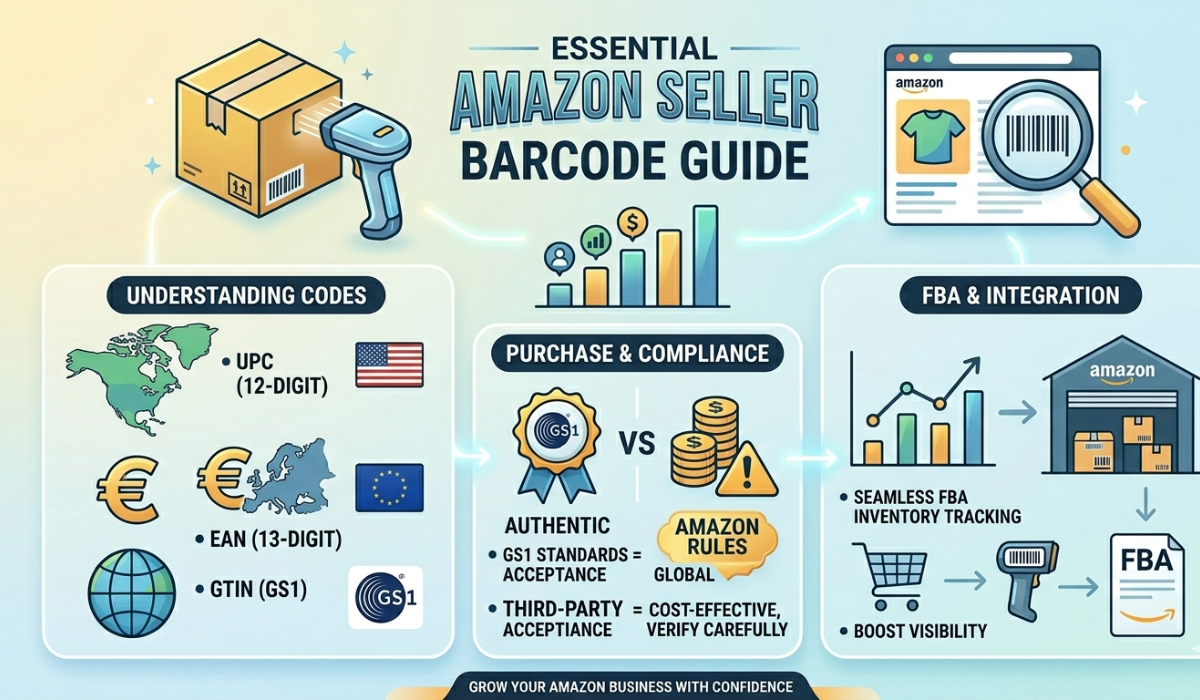
Standard barcode formats include:
- UPC (GTIN-12) for North America
- EAN (GTIN-13) for international markets
These codes are issued under global standards managed by GS1.
For brands planning international expansion, proper GTIN registration is required to:
- Clear customs
- Integrate with global retailers
- Sync with international distributors
- Avoid product identification conflicts
Global commerce depends on standardized product identifiers.
Google Shopping & Product Feed Integration
Shopify merchants using:
- Google Merchant Center
- Facebook Shop
- Instagram Shopping
- Multi-channel selling apps
Often need GTINs for product feed approval.
Barcodes support:
- Accurate product matching
- Rich product listings
- Improved ad performance
- Reduced feed disapprovals
Platforms use GTINs to match your products against global databases for better visibility and trust.
For sellers investing in paid ads and omnichannel marketing, barcodes enhance structured data reliability.
Brand Protection & Product Ownership Verification
Registered GTINs help establish clear product ownership.
This becomes important when:
- Protecting your brand identity
- Applying for brand registry programs
- Preventing listing hijacking
- Resolving catalog conflicts
Marketplaces and retail systems cross-check GTIN ownership against global registries.
When your barcode is properly registered, it strengthens your brand’s legitimacy and reduces disputes.
What Type of Barcode Is Required for Shopify Sellers?
The most commonly required formats are:
- UPC (Universal Product Code)
- EAN (European Article Number)
Both are part of the GTIN system and must follow international allocation standards.
A valid barcode must:
- Be globally unique
- Be registered to your company
- Match your brand name
- Pass checksum validation
- Scan accurately in POS systems
Serious ecommerce operations require compliant, verifiable GTINs. You can buy best GS1 UPC Barcodes for your online stores.
Why Barcodes Matter for Scaling Shopify Businesses
As your Shopify store grows, complexity increases.
You begin managing:
- Warehouses
- 3PL logistics providers
- Marketplace integrations
- Retail distributors
- Multi-channel inventory systems
Barcodes act as the universal product language connecting all these systems.
Without standardized identifiers, data conflicts and operational errors increase rapidly.
Barcodes bring structure, automation, and reliability.
Professional Shopify Sellers Plan for Infrastructure
Successful ecommerce brands treat barcodes as part of foundational infrastructure similar to:
- Trademark registration
- Product packaging design
- Payment gateway integration
- Inventory management systems
Investing in proper barcode systems early prevents:
- Costly packaging reprints
- Listing errors
- Retail rejection
- Marketplace account issues
- Inventory confusion
Growth-ready Shopify brands build compliance before expansion begins.
Final Conclusion
For Shopify sellers operating professionally, especially those expanding to marketplaces, retail, POS systems, or international distribution barcodes are a required component of ecommerce infrastructure.
They enable:
- Marketplace listing approval
- Retail onboarding
- POS scanning
- Variant-level inventory control
- Brand ownership verification
- Global distribution readiness
If your Shopify store is built for growth, scalability, and professional retail integration, properly registered barcodes are essential.